
How BIM Improves Miscellaneous Steel Detailing Accuracy
Miscellaneous Steel Detailing is fundamental in successfully completing construction projects today. While the primary structural elements (that is to say, beams and columns) are major players in the process, the importance of the smaller components must not be underestimated in terms of ensuring the safety, functionality, coordination, and completion of the project. Stairs, ladders, railing, platforms, embeds, hangers, brackets, and other miscellaneous steel details must be accurately mapped out to fit well into the project as a whole.
This is where Building Information Modeling (BIM) comes to play because it implies a new approach to how Miscellaneous Steel Detailing is performed. Rather than relying solely on the usual 2D drawings, BIM allows designers, architects, fabricators, contractors, and other project stakeholders to create a coordinated 3D model. With the help of this model designers can easily spot design flaws, eliminate errors, improve communication, and produce accurate fabrication and erection details.
For businesses who deal with complicated commercial, industrial, or civil engineering projects combining BIM with Miscellaneous Steel Detailing yields better accuracy and performance of the project.
What Is Miscellaneous Steel Detailing?
Miscellaneous Steel Detailing is the work of drawing up plans and 3D drawings of secondary and supporting steel items belonging to a building project. While these items will not take any of the main supporting load of the building, they are still crucial for the overall usability, safety, and functioning of the construction.
Common elements included in the scope of Miscellaneous Steel Detailing are:
- Steel stairs and stair stringers
- Handrails and guardrails
- Ladders and access platforms
- Walkways and maintenance platforms
- Steel brackets and supports
- Equipment supports
- Pipe supports
- Steel embeds
- Bollards
- Canopies
- Catwalks
- Grating and checker plates
- Safety cages
- Miscellaneous frames and connections
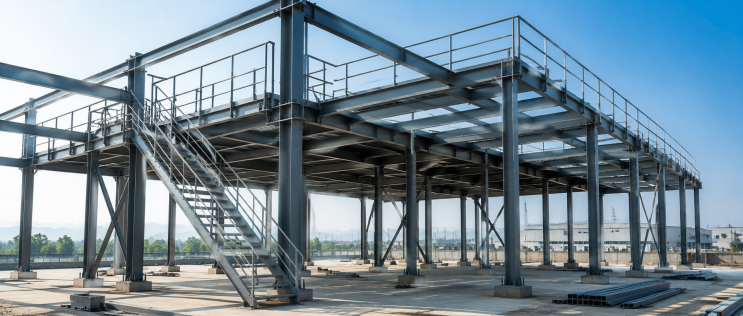
In detail, the Miscellaneous Steel Detailing services aim to use engineering and architectural data to provide all information required at fabrication and assembly stages. Drawing engineers need to be capable of producing drawings with precise dimensions, material specifications, weldings, bolts, type of connections, body dimensions and many other details needed by the fabricators and assemblers.
Given the fact that these steel elements connect with concrete, steel elements, MEP systems, equipment and architectural structures, any error in detailing may cause serious problems in the course of fabrication and installation.
Categories
- Steel Detailing
- Material Take-offs
- Structural Engineering
- BIM Modelling
- Architectural Services
- Paper to CAD Conversion
Miscellaneous Steel Detailing and the Importance of Accuracy
Accuracy is crucial in the field of Miscellaneous Steel Detailing. The secondary steel components are installed typically in locations where there is limited space, and multiple trades are working at the same time.
For instance, the platform is constructed around the mechanical equipment, the ladder connects the structural frame, and the handrail aligns with an architectural opening. If the dimensions are not accurate, the component will not fit.
The accuracy in Miscellaneous Steel Detailing will minimize the:
- Fabrication errors
- Material wastage
- Rework
- Delays in installation
- Changes at the site
- Coordination issues
- Added costs of the project
When the process of Checking the Miscellaneous Steel Detailing is done with the help of coordinated BIM workflow, the project team is able to view the steel elements in a 3D environment before their production.
Technology and Processing of the Miscellaneous Steel Detailing with the Help of the BIM
BIM introduces the connected and visual nature of work in the area of Miscellaneous Steel Detailing. Instead of analyzing the particular drawing, the detailers are able to create and coordinate the detailers with the help of one digital model.
How BIM Enhances the Precision of Miscellaneous Steel Detailing
BIM allows for a more connected and visual method of Miscellaneous Steel Detailing than ever before. The detailing team can design and track their steel components within a complete model rather than checking each drawing around.
Here are some of the major benefits of BIM for Miscellaneous Steel Detailing:
1. Clear 3D View of Steel Components
The most important aspect of BIM-based Miscellaneous Steel Detailing is the opportunity to demonstrate steel components in 3D.
Conventional 2D drawings can make it difficult to grasp how a stair, platform, bracket, or handrail interacts with the environment. Using a 3D BIM model allows for better representation of how a designed building looks like.
The detailers can see the following:
- Member locations
- Steel connections
- Clearances
- Elevations
- Access points
- Component relationships
This visual comprehension enables the team to detect possible challenges long before steel arrives to the workshop or site.
2. Minimizes Design and Coordination Mistakes
Mistakes in Miscellaneous Steel Detailing arise due to improper coordination of information from various trades. Structural steel elements can face architectural work, ventilation and air conditioning systems, plumbing, electricity systems, and other equipment.
BIM combines this information in a single, digital environment. This allows the detailing team to understand how various steel components of different buildings work together.
For instance, improperly designed platforms may create problems of access in the presence of piping. The use of BIM technology in Miscellaneous Steel Detailing allows early detection of such issues.
3. Helps in Early Clash Detection
It is important to detect clashes during Miscellaneous Steel Detailing. Since secondary steel is installed in overcrowded workspaces, it needs to be done carefully.
BIM technology allows clash detection between:
- Steel and concrete
- Steel and MEP services
- Steel and equipment
- Stairs and construction items
- Platforms and piping
- Handrails and access roads
Finding the problems at the modeling stage is more effective than detecting them during installation.
With efficient Miscellaneous Steel Detailing, it is possible to solve issues before they arise on-site.
4. Enhances Dimensional Accuracy
In Miscellaneous Steel Detailing, getting the right dimensions is important. An inaccurate dimension can invalidate the entire steel assembly fit and installation.
BIM enables detailers to work with accurate geometries and synchronized project data. Moreover, the dimensions can be checked directly in the BIM model, which minimizes the chances of errors in measurements.
This is particularly useful for complex features such as:
- Curved handrails
- Steel stairs
- Platforms
- Ladders
- Equipment supports
- Custom brackets
The accuracy of the modeling process enhances the reliability of Miscellaneous Steel Detailing and helps fabricators get more information.
5. Makes Connections Easier to Visualize
Connections are an important part of Miscellaneous Steel Detailing. Different types of bracket designs or types of connections include bolts and welds.
A BIM model helps detailers to visualize the connections from different perspectives.
Moreover, with the help of well-coordinated models, the Miscellaneous Steel Detailing drawings can provide data such as:
- Bolt location.
- Weld specifications.
- Plate size.
- Connection parts.
- Orientation of the members.
- Assembly relationships.
This helps fabricators understand the intended construction more clearly.
6. Enhances the Accuracy of Shop Drawings
The primary objective of miscellaneous steel detailing is to achieve accurate fabrication and building.
Using BIM, detailers create detailed shop drawings with the help of an organized model. According to the project needs and applicable information technology procedures, detailers create information that can then be used for production drawings, assembly drawings, erection drawings, and other types of drawing.
The use of precise shop drawings allows manufacturers to know how to make each steel component.
The better coherence of the model and shop drawings results in fewer discrepancies in miscellaneous steel detailing process and improves the quality of fabrication.
7. Reduces Rework and Material Waste
Wrong miscellaneous steel detailing can lead to the steel being produced wrongly. Such a situation forces the manufacturer to either modify the product or make it from scratch.
The following consequences arise:
- Wasted materials
- Increased labor costs
- Production delays
- Transportation issues
- Site installation problems
BIM minimizes all these risks through the possibility to review the drawing digitally before fabricating the product.
This is why the use of BIM in the process of miscellaneous steel detailing allows for better capitalization of materials and decrease of unnecessary rework.
8. Enhances Team Work in Projects
Efficient Miscellaneous Steel Detailing is determined by how these project participants exchange information with one another.
The participants might include:
- Structural engineers
- Architects
- Steel detailers
- Manufacturers
- General contractors
- Steel erectors
- MEP specialists
BIM technology offers a space for communication between the participants regarding the project. Instead of using separate drawings and emails, the participants can share a common working model.
This promotes good communication and contributes to the organization of the process of Miscellaneous Steel Detailing.
9. Improves Planning for Fabrication and Installation
BIM-based Miscellaneous Steel Detailing allows for understanding how components will be manufactured and installed.
The team will have an opportunity of visualizing the order of installation of metallic elements before the beginning of physically constructing the building. Planning can be of special importance for large-scale projects where access and installation conditions are crucial.
For example, it may be necessary to break large platforms into smaller parts for transportation and installation purposes. Analyzing the model allows determining the most effective strategy for building erection.
This makes Miscellaneous Steel Detailing more than a drawing process. It plays an important role in project planning.
10. Helps Maintain Consistency Across Project Documentation
Large construction projects often involve hundreds or thousands of steel components. Maintaining consistency across drawings, schedules, and models can be challenging.
BIM helps create a centralized source of project information. When the model is properly managed, changes can be coordinated more efficiently across the Miscellaneous Steel Detailing workflow.
This helps reduce the risk of one drawing showing outdated information while another contains a revised detail.
Conclusion
Miscellaneous Steel Detailing plays an important role in achieving safe, accurate, and efficient construction. Even small steel components such as stairs, platforms, ladders, handrails, brackets, and supports require precise detailing to avoid fabrication and installation problems. BIM makes this process more reliable by providing a coordinated 3D environment where project teams can identify clashes, verify dimensions, review connections, and resolve issues before fabrication begins.
By combining BIM technology with professional Miscellaneous Steel Detailing, construction teams can reduce errors, minimize rework, improve shop drawing accuracy, and support smoother fabrication and installation. It also improves collaboration between engineers, architects, detailers, fabricators, contractors, and erectors.
As construction projects continue to become more complex, accurate Miscellaneous Steel Detailing supported by BIM can help companies improve project quality, save time, reduce unnecessary costs, and achieve better overall project coordination.

Experienced and Tekla-certified team
Multi-discipline expertise (Steel, BIM, Civil, Structural)
Flexible project scaling and delivery models
Transparent communication and quick turnaround
Request a Free Estimate
Whether you’re in the planning phase or ready to begin, we provide transparent, no-obligation estimates for all types of structural and detailing work.
- Expert structural & detailing solutions
- Global delivery (India, USA, Canada)
- BIM & Tekla-enabled workflows
- Fabrication-ready, code-compliant output
- Fast, clear communication
- Competitive & flexible pricing